
304 vs 316 Stainless Steel Grating: How to Choose
Use 304 for many dry, indoor and general industrial locations. Consider 316 when chloride exposure, coastal air, salt spray or aggressive cleaning chemicals materially increase corrosion risk.
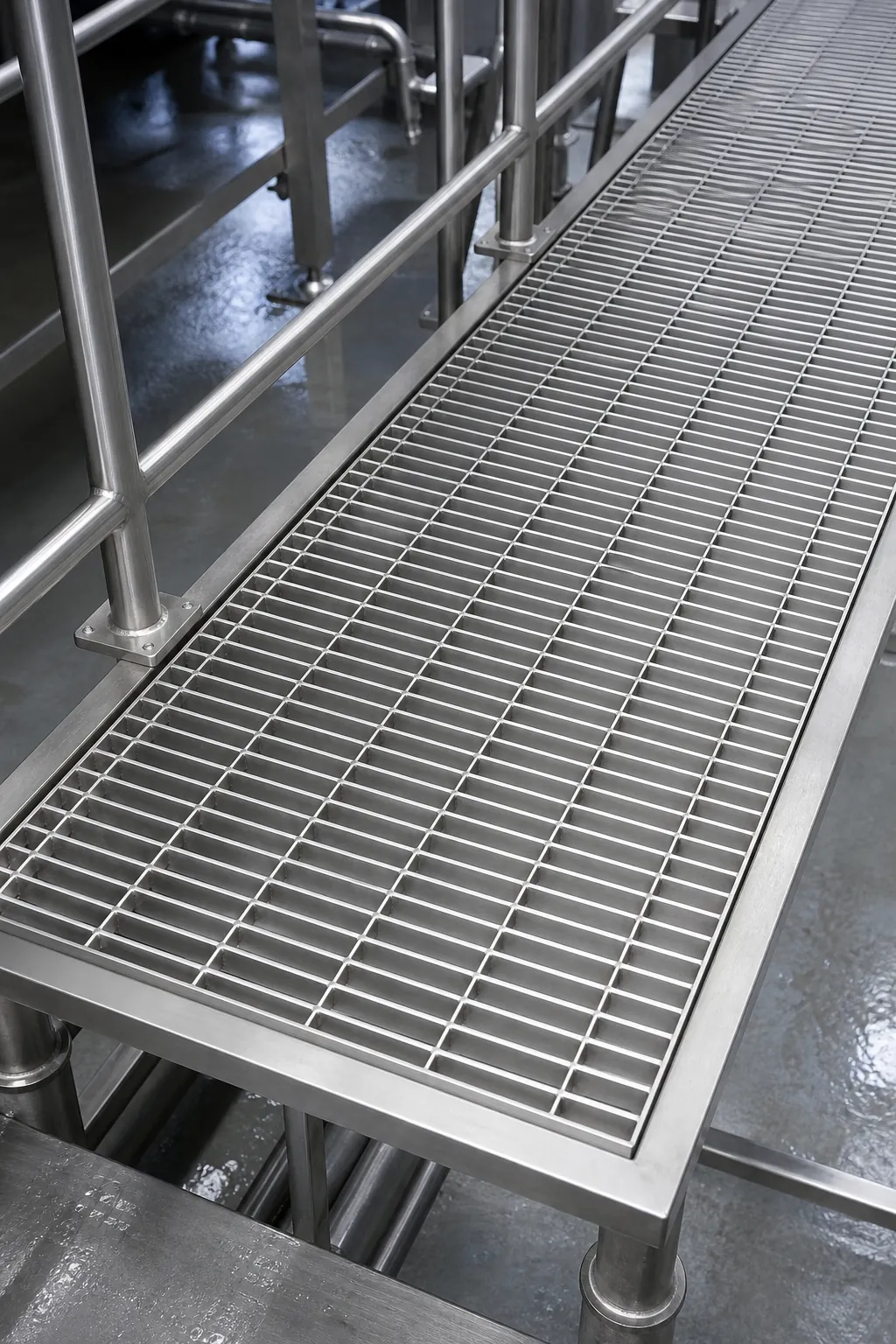
What is the practical difference?
Both 304 and 316 are widely used austenitic stainless steels. The key purchasing difference is that 316 contains molybdenum, which generally improves resistance to localized attack in chloride-bearing environments. That does not make the grating immune to corrosion. Poor drainage, trapped salts, incompatible cleaners and contaminated fabrication tools can still create problems.
When is 304 stainless grating a sensible choice?
304 is commonly considered for dry internal platforms, food or process areas with controlled cleaning, architectural access areas and general industrial locations without meaningful chloride exposure. It can provide a clean appearance and avoids the zinc coating used on carbon-steel grating.
Before specifying 304, record the chemicals present, washdown method, temperature, deposit risk and expected cleaning frequency. “Indoor” alone is not a complete environmental description.
When should a buyer consider 316?
316 is commonly evaluated for coastal sites, marine facilities, salt-handling areas, chloride-containing washdown, some water-treatment zones and process environments where localized corrosion is a concern. The decision should be based on actual concentration, temperature, wetting cycle and design life. For severe exposure, a corrosion specialist may recommend a different alloy or material system.
Do finish and fabrication matter?
Yes. Surface condition influences cleanability and the retention of deposits. Weld heat tint, embedded carbon-steel particles and rough fabricated areas can reduce local corrosion performance. Define the required finish, weld treatment and cleaning or passivation process when these are important. Fabrication should use suitable tooling and handling controls to reduce cross-contamination.
How should the two options be compared?
- Required grade and applicable material specification.
- Grating type, bearing-bar dimensions and mesh.
- Clear span, load case and allowable deflection.
- Surface profile, finish and fabrication after welding.
- Cut-outs, banding, nosing, clips and support interfaces.
- Material certificates, piece identification and inspection records.
- Initial price, cleaning requirement and expected service life.
RFQ wording example
A useful RFQ does not say only “stainless grating.” It identifies the grade, product geometry, panel schedule, surface, finish, fabrication and documentation. Include environmental information if you want the supplier to comment on suitability, but keep final material selection with the responsible project engineer.
Frequently asked questions
Is 316 always better than 304?
No. It generally has better chloride resistance, but 304 may be the economical and technically adequate choice in a less aggressive environment.
Can the grade be confirmed by appearance?
No. Request material certificates and traceability where grade identity is a project requirement.
Should stainless grating be painted?
Usually stainless is selected for its own corrosion resistance and appearance, but project-specific coatings may be used. Confirm compatibility and surface preparation with the coating supplier.
Send your environment, span, load and panel schedule for a project-specific quotation.