
Trench Covers and Drainage Grating Selection Guide
How to select trench covers for industrial drainage, cable trenches, and trafficked areas: product types, load classes, materials, dimensions, and what to include in your specification package.
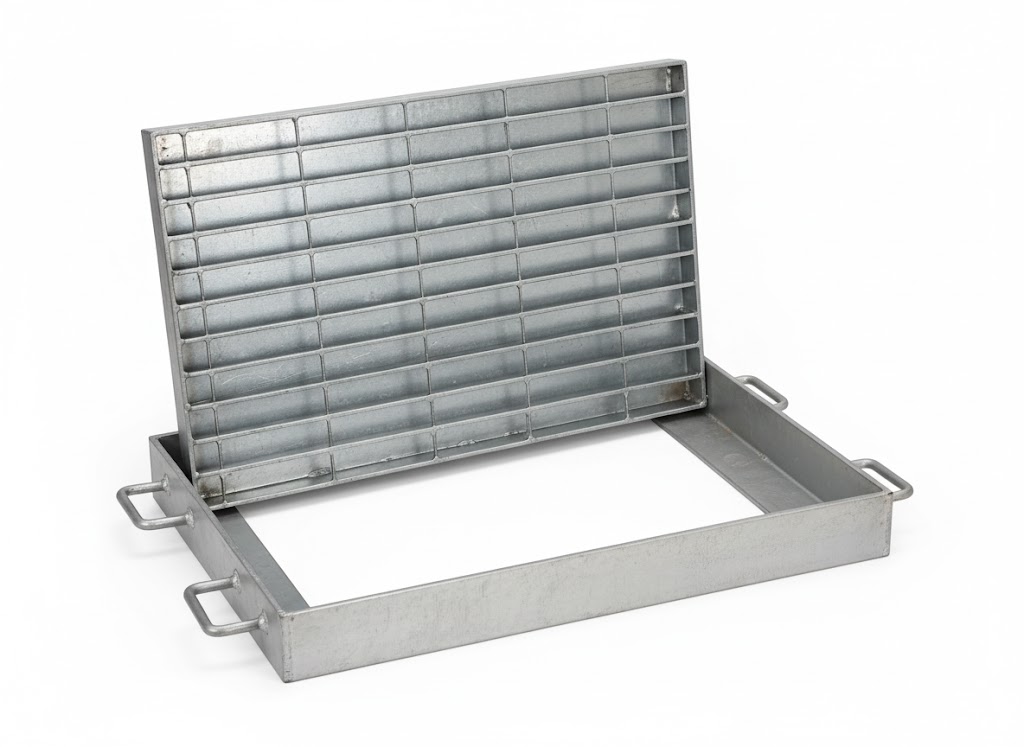
Trench covers close openings in floor slabs, pavements, and utility trenches while maintaining access for inspection, cleaning, and cable routing. In industrial facilities they protect personnel from falls into channels, keep debris out of drainage runs, and distribute wheel loads into supporting frames or kerb seats. The correct cover reduces maintenance, avoids premature failure from overload or corrosion, and supports safety during normal operations and shutdown work.
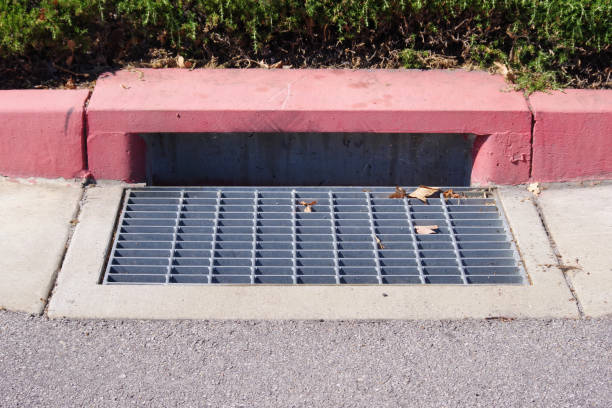
Product types for different duties
Most projects fall into one of three families, each suited to a different combination of traffic, span, and hydraulic requirement.
Standard, heavy-duty, and channel-matched covers
- Standard trench covers suit light industrial walkways, internal plant aisles with occasional pallet trucks, and covered trenches where design loads are moderate. For typical specifications and patterns, see standard trench covers.
- Heavy-duty trench covers are intended for fork trucks, delivery vehicles, and yard traffic crossing long spans or wide openings. They use thicker bearing bars, closer spacing, or composite construction to limit deflection. Details and options are summarized under heavy-duty trench covers.
- Drainage channel covers match modular linear drainage systems and slot channels. Selection must align grate free area, inlet geometry, and hydraulic capacity with the channel manufacturer’s frame. Refer to drainage channel covers when the cover is part of a continuous run rather than a single pit or trench bay.
Across all types, verify that the rated load class, clear opening, and frame interface match the as-built trench or channel—not only the nominal catalogue width.
Load class ratings (EN 124 and AASHTO context)
EN 124 covers complete manhole-top and gully-top assemblies within its scope and defines classes A15 through F900 by test load and installation group. It does not convert a class number into vehicle or axle tonnage, and it does not automatically rate an open steel-grating panel. North American road work may instead reference AASHTO or municipal load models. Confirm the governing contract standard before sizing the cover, frame, restraint and anchors.
| EN 124 class | Proof load (design test) | Typical applications | AASHTO / site notes |
|---|---|---|---|
| A15 | 15 kN | Group 1: areas used only by pedestrians and pedal cyclists | Complete assembly verification where EN 124 applies |
| B125 | 125 kN | Group 2: footways, pedestrian areas and comparable car parks | Does not prescribe one grating model or frame size |
| C250 | 250 kN | Group 3: kerbside channel/gutter locations defined by the standard | Installation location controls; do not infer from vehicle name |
| D400 | 400 kN | Group 4: road carriageways and comparable vehicle areas | Verify the complete cover-and-frame assembly |
| E600 | 600 kN | Group 5: areas imposing high wheel loads, such as docks or aircraft pavements | Project load data and applicable standard still govern |
| F900 | 900 kN | Group 6: areas imposing particularly high wheel loads, such as aircraft pavements | Specialist assembly design and verification required |
When traffic mixes forklifts and occasional full trucks, specify the worst credible wheel load and contact patch, then select a class with margin for dynamic effects and misalignment during installation.
Load class alone does not address vibration, noise, or visible sag. Where floors must stay plane after settlement, state maximum deflection under service load. For drainage runs, confirm inlet capacity and whether effluent is storm water only or carries process chemicals.
Materials and finishes
Steel and coatings
Steel trench covers are usually supplied hot-dip galvanized after fabrication for corrosion resistance in wet plant areas, wash-down zones, and outdoor trenches. Specify coating thickness and whether threads or mating surfaces must be protected or retapped after galvanizing.
Untreated or primed steel may be acceptable for temporary covers, indoor dry environments, or when the owner will apply a site-specific coating system. Document the expected exposure; untreated steel in damp channels will scale quickly.
Composites and stainless
FRP (fibre-reinforced polymer) covers offer high strength-to-weight ratio and electrical non-conductivity where stray currents or non-metallic requirements apply. Compare temperature limits, UV exposure, and support spacing with steel options before substituting material.
Stainless steel suits food, pharmaceutical, and aggressive chemical environments where zinc is unsuitable. Match grade (304 vs 316) to chloride exposure and specify passivation when the contract requires it.
Key dimensions and frame compatibility
Procurement errors most often come from ambiguous dimensions. Clarify the following in drawings and the bill of materials:
- Clear opening—the net length and width of the void the cover must span without bearing on loose fill or unsupported edges.
- Bearing length—the contact width on each side resting on the frame shoulder, kerb, or rebate; insufficient bearing causes edge cracking in concrete and rattling under traffic.
- Frame compatibility—rebate depth, bolt hole pattern, and whether the frame is cast-in, bolt-down, or surface-mounted must match the cover’s seating face and locking hardware.
If you are replacing covers on an existing trench, field-measure the opening and frame after any concrete repairs, not from original construction drawings alone.
Installation and safety features
Frame type drives long-term performance: rigid, well-anchored frames maintain alignment; flexible or poorly shimmed frames telegraph impact loads into the cover corners. Specify whether covers must be removable for full access (lift-out) or hinged for frequent inspection with reduced manual handling.
For trafficked locations, consider safety locking—bolts, captive screws, or locking bars—to prevent displacement from vibration or tire shear. Locking supports lockout/tagout where covers protect energized trenches. Coordinate lift weight limits with site safety rules.
Common applications
Factories and process plants should submit forklift or truck wheel loads, tire footprints, speed/turning conditions and trench support details. Roads and logistics yards must follow the governing road or drainage standard. Airports and ports require specialist pavement and equipment load data. Power plants and substations should also state cable-access, drainage, corrosion and electrical requirements. A class label is an input only when the applicable standard and complete assembly scope are confirmed.
Specifying and ordering
An RFQ that includes the governing standard, clear opening, support seat, bearing direction, wheel or pedestrian load, contact footprint, traffic dynamics, frame details, material and finish reduces rework and shortens quotation time. For a structured checklist, use How to Specify alongside this article. When you are ready to send quantities and drawings, submit details through Request a Quote.
Include at minimum the following in your enquiry package:
- Plan and section sketches with clear opening dimensions and tolerances.
- Target EN 124 class (or equivalent AASHTO/municipal duty) and any deflection limits.
- Traffic mix and frequency of lift-out or hinged access.
- Material and finish—galvanized, stainless, primed, or FRP—and invoked coating standards.
- Frame type, anchorage constraints, quantity, delivery region, and required test reports.
For the wider product range, see Trench Covers. For a use-case overview with recommended patterns, read drainage covers (applications).