
Steel Grating Weight per Square Meter: Formula and Worked Example
For rectangular steel bearing bars, the theoretical bearing-bar mass can be estimated from bar depth, thickness, steel density, and pitch. Cross bars, banding, fabrication and finish must then be added.
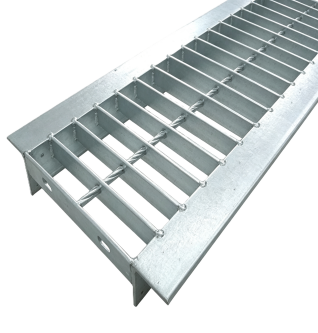
Steel grating weight formula
For a rectangular carbon-steel bearing bar, the mass of one metre of bar is approximately:
bar mass (kg/m) = depth (mm) × thickness (mm) × 0.00785
The approximate number of bearing bars across one metre is 1000 divided by bearing-bar pitch. Combining the two gives:
bearing-bar mass (kg/m²) ≈ depth × thickness × 7.85 ÷ pitch
This is only the bearing-bar component. Cross bars, end banding and fabricated details must be added to obtain the panel weight.
Worked example: 30 × 3 mm bars at 30 mm pitch
Using the formula: 30 × 3 × 7.85 ÷ 30 = 23.55 kg/m² for the bearing bars. The finished grating will be heavier after cross bars, banding and any zinc coating are included.
For a rectangular panel, multiply the finished unit mass by net panel area. For example, a 1.0 m × 1.2 m panel has 1.2 m² of gross area before deductions or special fabrication are considered.
What must be added to theoretical bearing-bar weight?
- Twisted square, round or flat cross bars.
- End banding and load banding.
- Toe plates, kick plates, nosing and lifting details.
- Hinges, frames or attached structural sections.
- Hot-dip galvanized coating or other finish.
- Fasteners and separate accessories when shipping weight is required.
How mesh spacing changes kg per square metre
Closer bearing-bar spacing means more bars per metre and therefore more weight. With the same bearing-bar size, reducing pitch from 40 mm to 30 mm increases the bearing-bar count by roughly one third. Cross-bar spacing also changes total mass, although the effect is usually smaller than changing the main bearing bars.
Why calculated and quoted weights differ
Differences can come from dimensional tolerances, actual bar profile, serration, cross-bar type, edge treatment, panelization, cut-outs and the supplier's takeoff method. Some quotations show theoretical net weight; others show finished or shipping weight. The quotation should label each number clearly.
Weight needed for pricing, lifting and freight
Use theoretical weight for early budgeting and quotation comparison. Use approved finished-panel weight for lifting plans. Use gross packed weight for freight and container planning. These figures answer different questions and should not be substituted for one another.
Steel grating weight RFQ checklist
- Bearing-bar depth, thickness and spacing.
- Cross-bar type and spacing.
- Panel length, width, quantity and piece marks.
- Material, serration and finish.
- Banding, cut-outs, toe plates and attached items.
- Required net, finished and gross shipping weights.
Frequently asked questions
How do you calculate steel grating weight per square metre?
For rectangular bearing bars, multiply depth by thickness by 7.85 and divide by bearing-bar pitch, all in millimetres. Then add cross bars, banding and fabrication.
Does galvanizing increase grating weight?
Yes. Zinc adds weight. The exact increase depends on coating mass, surface area, drainage and finished geometry.
Can I use this formula for final shipping weight?
No. Use it for an estimate. Ask the supplier for the approved BOM and gross packing list. Send your grating schedule for a project-specific weight review.