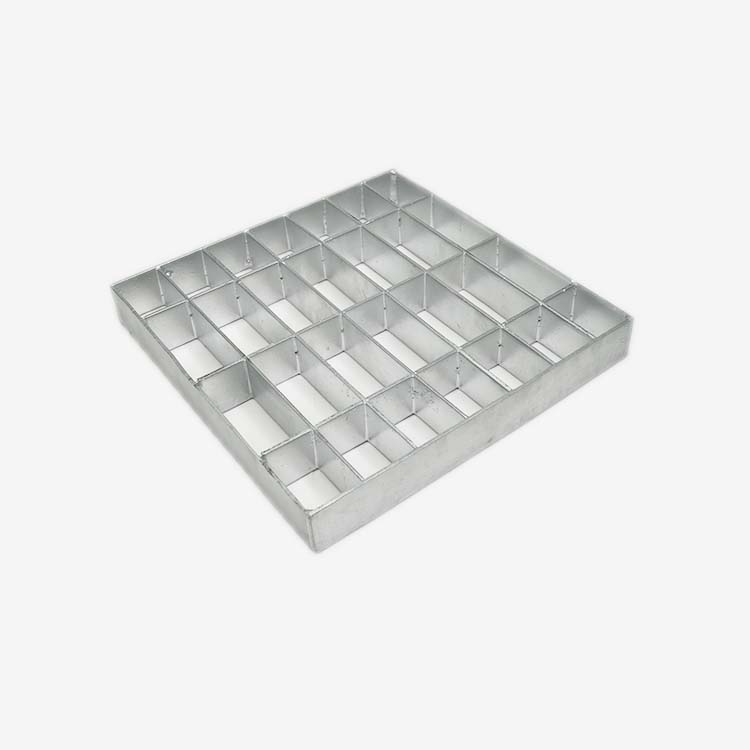
Press-locked steel bar grating (flush face)

Cross bars are mechanically locked into bearing bars — no fusion weld at each crossing. The walking plane stays smooth at intersections; capacity and deflection still follow project checks and released data.

Schematic plan view of press-locked steel bar grating
Plan schematic — illustrative only.
Schematic mechanical lock at crossing without weld
Mechanical interlock at crossing.
Press-locked steel bar grating panel photograph
Physical panel reference—compare with diagrams above.

Engineering note: Smooth crossings do not remove the need for span, load, and deflection verification. Use released load tables only for the matching construction type and assumptions. Quotation and drawings govern.

Specify press-locked construction in millimetres: bearing bar, s₁ and s₂, plain or serrated, finish, panel, span direction. Compare with welded grating when a fusion weld at each crossing is acceptable. Naming: spacing guide, how to specify.

Common references (GB + US)

Use caseGB / YB style (metric)US / NAAMM reference
Most common press-lockedP325/30/10019P4
Lighter dutyP255/30/10015P4
Close meshP325/30/5019P2

Verify every label against quoted mm geometry.

Typical press-locked grating applications

Data centers

Clean-appearance mezzanines and service bridges where weld beads are undesirable for washdown or architectural bands next to glass facades.

Power generation

Indoor auxiliary platforms in control buildings or BOP areas where a flat bottom face simplifies lighting or cable tray layout beneath the walk.

Oil & gas

Onshore LNG balance-of-plant walkways when owners want uniform mesh appearance and predictable panel flatness for gasketed edge details.

Compare and specify

Structural check remains mandatory

Flush faces do not remove the need for span/load verification. Compare against load tables and document fixings with clips.

Frequently asked questions

Is press-locked grating weaker than welded?

Not inherently—capacity follows bar size, spacing, and span. Some meshes overlap between welded and press-locked families; verify the quoted panel against the same deflection criteria used for welded options.

Why choose press-locked over welded?

Mechanical locking yields smooth top and bottom surfaces without weld ripples—preferred in food, pharma, and architectural sightlines.

Can press-locked panels be galvanized?

Yes when venting and drainage follow galvanizer rules. Confirm distortion limits for thin bars with your supplier.

What fixings suit press-locked panels?

Saddle and hold-down clips from the accessories range; torque and substrate material must match the support steel.

How is mesh designated on drawings?

Use factory spacing codes or section properties referenced to spacing guide notes.

Is serrated press-locked available?

Yes where the top face must improve wet traction; confirm availability for the mesh you select.

Need a quotation?

Send product type, spacing, material, finish, panel size, quantity, and drawings.

Request a Quote