
How to Choose Steel Grating: Complete Guide
This guide is written for people who must put a number on a drawing: clear span, factored load, deflection limit, mesh pattern, material, and finish. Marketing labels do not hold up in an RFQ—those inputs do.
Introduction
Steel bar grating is not a single product. It is a family of open-grid floors built from bearing bars (primary direction) and cross bars, with optional changes to bar depth, thickness, spacing, surface (plain or serrated), and edge banding. The correct choice is always the intersection of structure (can it carry the load at the span you actually have?), environment (what attacks the steel or coating?), safety (slip and drop-through), and documentation (which standard or owner spec must the mill certificate satisfy?).
If you only know “walkway over a pipe rack,—you are one step behind. If you know —.2 m span, 5 kPa service uniform load, L/200 deflection, outdoor C3 atmosphere, plain top unless HSE flags slip risk,—you can narrow the field in minutes and compare quotations fairly.
Step 1: Fix the structural inputs
Before comparing welded versus press-locked grating, fix the geometry that governs bending:
- Clear span between primary supports (beam flange, angle, channel), not the nominal bay width.
- Load model: uniform load (kN/m² or psf), point or line load from equipment wheels, maintenance bins, or a defined patch load.
- Deflection limit under service loads—common values are span/200 or span/250 for access floors; tighter limits appear near sensitive instruments or when owner standards override defaults.
- Bearing bar direction must run across the span so the deeper member resists bending. A common shop mistake is rotating the panel 90° on site.
Use published load tables or supplier calculations; do not “size by photograph.—If your load exceeds catalog tables, move to deeper bars, tighter spacing, or heavy-duty welded grating rather than guessing a trade name.
Step 2: Pick the mesh family
Welded bar grating
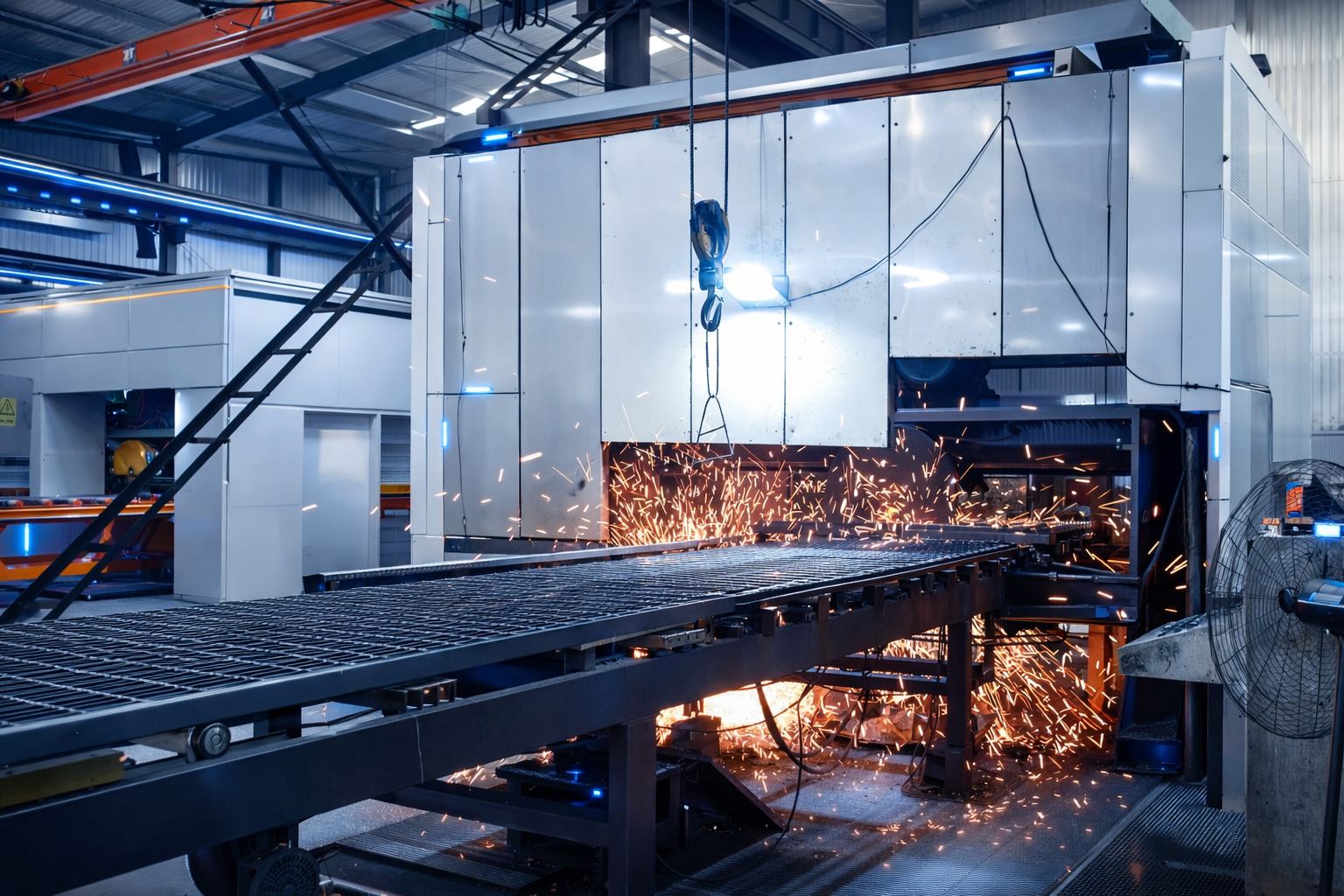
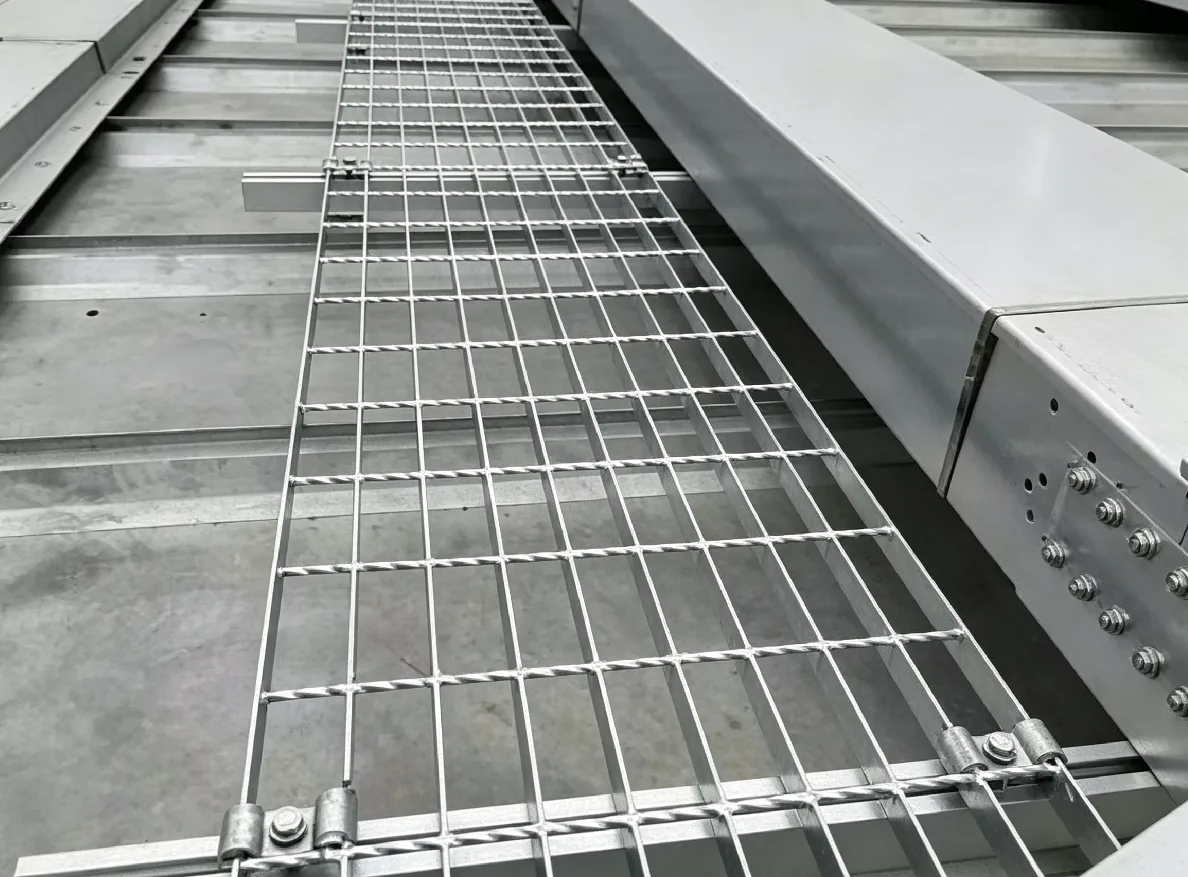
Welded steel bar grating is resistance forge-welded at each crossing. It is the default for process plants, power stations, warehouses, and offshore modules where contractors expect NAAMM-style or GB-style designations (for example 19-W-4 or G325/30/100—always confirm against the table you quote).
Serrated surface
When the service environment includes rain, condensate, lubricants, or food fats, specify serrated bearing bars. The structural mesh can match a plain panel; the change is chiefly frictional, not an excuse to skip a load check.
Press-locked grating
Press-locked grating swages or locks cross bars into slotted bearing bars. It yields flat faces without weld beads—valuable in food, pharma, and architectural bands—yet still needs the same load documentation as welded mesh.
Close-mesh and ball-proof patterns
Close-mesh and ball-proof configurations shrink openings to reduce dropped objects or meet rules on sphere passage. Expect higher steel weight per square metre and reduced open area for drainage.
Composite (checker plate top)
Composite grating laminates a solid checker plate to open mesh when nothing may fall through or when small wheels must roll across. Drainage stops unless you detail cutouts; say so in the spec.
Step 3: Decide when steel should not be steel
Corrosive atmospheres, strong intermittent chemicals, or strict electrical isolation may push the design toward FRP grating in matched resin systems. That is a materials decision, not a cosmetic one. If you stay with steel, align finish choice with materials and finishes guidance and maintenance reality on site.
Step 4: Finishes and grades
Carbon steel plus hot-dip galvanizing after fabrication remains the bulk industrial specification. Stainless grades enter when chloride exposure, bleach washdown, or pitting risk makes zinc uneconomic over the plant life. Untreated or painted steel may suffice indoors in dry conditions or when a site coating system is applied under a separate spec. Sherardized zinc diffusion coatings appear on clips and small components where galvanizing bath size is limiting.
Step 5: Lock the standard and the RFQ package
Owners in North America may reference ANSI/NAAMM MBG 531, while Chinese supply chains commonly quote YB/T 4001. European requirements must be checked for the exact product and intended use; EN 1090 is an execution and conformity-assessment route for structural components, not a universal grating specification. Standards are not interchangeable: dimensions, tolerances and evidence differ. List the governing design and product documents, material certificate requirement, galvanizing standard and inspection plan in the enquiry. A concise template lives in how to specify grating.
Practical selection checklist
- Span, support type, and bearing bar orientation confirmed on the drawing.
- Uniform and concentrated loads stated with load factors or described as “service—versus “ultimate—so the supplier applies the same safety philosophy.
- Deflection cap stated numerically.
- Open-area or drainage requirement stated if trench run-off matters.
- Slip strategy: plain vs serrated; special nosing if the panel becomes a stair tread.
- Edge condition: banded, cut-out for structure, or trench cover frame interface.
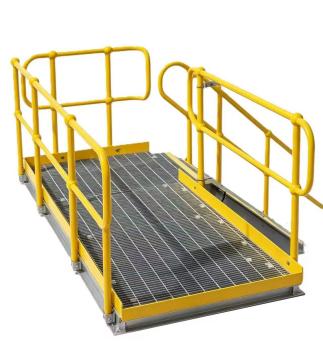
- Fixings: saddle clips, bolted lug, or weld tabs—coordinate with accessories.
Related technical pages
For load-based selection, read steel grating load capacity explained. For clip and fixing documentation, read hold-down clips and grating fixings. For material trade-offs, see steel grating vs FRP grating. Use-case hubs: platform flooring, industrial walkways. Sector context: data centers and power plants. When you are ready to price panels, use the RFQ form.
Frequently asked questions
What do I need before I can choose a grating type?
Clear span between supports (or support layout), factored loads (uniform kN/m² and/or point load kN), allowable deflection (often span/200 or span/250 for walkways), bearing bar direction relative to span, and environment (indoor dry, outdoor, chemical splash, food washdown). Without span and load, any grating choice is arbitrary.
When is welded bar grating the right default?
Welded bar grating is the usual default for industrial platforms and walkways when loads are moderate to high and an open mesh is acceptable. Forge-welded joints at every crossing give predictable strength and the widest range of bar sizes and spacings. Use published load tables for your span.
When should I specify serrated bearing bars?
Specify serrated grating when the walking surface may be wet, oily, or frosted and slip resistance is part of the hazard assessment. Serrations increase shoe contact friction without changing the structural mesh if bar size and spacing are held constant.
What problem does press-locked grating solve?
Press-locked grating gives flush top and bottom faces with no weld beads—useful for architectural zones, food plants that care about cleanability of the mesh, and details where weld distortion is undesirable. Strength still comes from bar dimensions and spacing checked against loads.
Why would I use close-mesh or ball-proof grating?
Close-mesh reduces opening size so small parts or debris are less likely to fall through. Ball-proof patterns address rules that limit passage of a reference sphere through the mesh. These choices trade open area and weight for drop protection.
How does heavy-duty grating differ from standard welded grating?
Heavy-duty grating uses deeper and/or thicker bearing bars and often tighter cross bar spacing to carry wheel loads, pallet jack loads, or high concentrated forces. Specify it when standard-duty tables are insufficient for the factored load at the actual span.
Galvanized carbon steel or stainless?
Hot-dip galvanized carbon steel is the workhorse for general industrial and outdoor exposure. Stainless (304/316L) suits chlorides, aggressive washdown, or process chemistry that shortens zinc life. Balance first cost against maintenance and downtime.