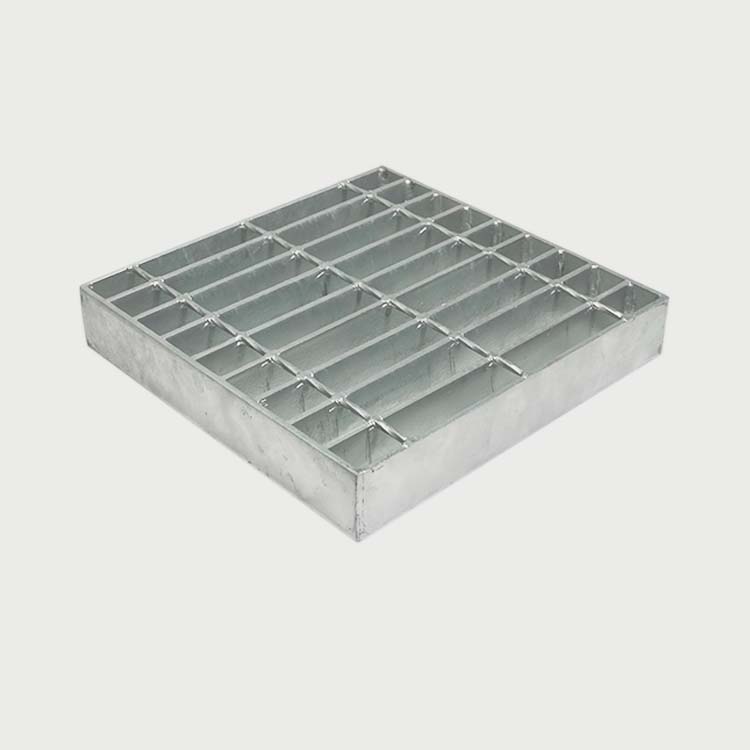
Welded steel bar grating for platforms and walkways
Bearing and cross bars joined by forge (pressure) welding at each crossing — a rigid open grid for platforms, walkways, and trench covers.
Engineering note: Geometry, loads, materials, and finishes are confirmed on the quotation and approved drawings. Use released load tables only under their stated assumptions.
Specify in millimetres: bearing bar, pitches s₁ and s₂, plain or serrated, material, finish, panel size, and span direction. Naming: spacing guide, how to specify.
Common models (GB + US)
| Model / designation | Description | Typical use |
|---|---|---|
| G305/30/100 ★ | 30×5 bearing bar | Most common welded type |
| G325/30/100 ★ | 32×5 bearing bar | Heavy-duty platforms |
| G255/30/100 | 25×5 bearing bar | General platform use |
| 19-W-4 ★ | Standard welded grating | Industrial platforms, walkways |
| 15-W-4 | Closer spacing | Higher load / smaller openings |
| 19-W-2 | Cross bar @ 2" | Heavy-duty applications |
★ = most frequently specified models.
Where welded bar grating is specified
Data centers
Mezzanine maintenance decks, cable-bridge approaches, and outdoor generator yards often use galvanized welded mesh when loads and spans match standard tables. Coordinate open area with mechanical if the walk is near containment boundaries.
Power generation
Turbine auxiliary platforms, boiler access, and coal-handling galleries standardize on forge-welded mesh for wheel paths and tool loads. Serrated tops are common in steam-adjacent zones—pair with the correct span in released load tables.
Oil & gas
Pipe racks, module walkways, and offshore cellar decks specify welded grating for high familiarity in fabrication yards. Quote ball-proof or close-mesh variants where dropped-object rules apply.
Related products and engineering
- Load tables
- Serrated bar grating
- Heavy-duty welded grating
- Stair treads
- Trench covers
- Load capacity explained (guide)
- Request a quote
Design inputs that belong on every RFQ
State clear span, bearing bar direction, uniform and concentrated loads, deflection limit, material (carbon vs stainless), and finish. Cross-check mesh names against our spacing guide and selection guide.
Frequently asked questions
How does welded bar grating differ from press-locked?
Welded grating fuses cross bars to bearing bars at every intersection with a forge weld. Press-locked grating mechanically locks bars without weld beads. Both can meet similar duties if bar sizes and spacing are chosen to match loads at the quoted span.
Which designation is most common for industrial platforms?
Projects reference GB-style meshes such as G325/30/100 or NAAMM-style 19-W-4 depending on region. The designation fixes bar depth, thickness, and pitch—always tie it to a load table row for your span.
Can welded grating be hot-dip galvanized after cutting?
Yes, with attention to venting and drainage holes per galvanizing practice. Field cuts after galvanizing expose bare steel and need zinc repair per project standards.
What slip treatment pairs with welded mesh?
Specify plain or serrated bearing bar tops. Serrated improves wet/oily traction without changing mesh identification if bar dimensions stay the same.
How do I avoid the wrong bearing bar direction on site?
Show bearing bar orientation relative to supporting beams on the drawing and repeat it in the RFQ. Installation rotated 90° from design sharply reduces capacity.
Where do composite or close-mesh variants fit?
Use close-mesh or ball-proof patterns for drop protection; use composite when a solid top is required.
Do you supply cut-to-size panels?
Yes—provide net dimensions, banding, and notch details so quotations match fabrication and tolerances.
Need a quotation?
Send product type, spacing, material, finish, panel size, quantity, and drawings.